How to Create Claude Code Skills for Content Creation
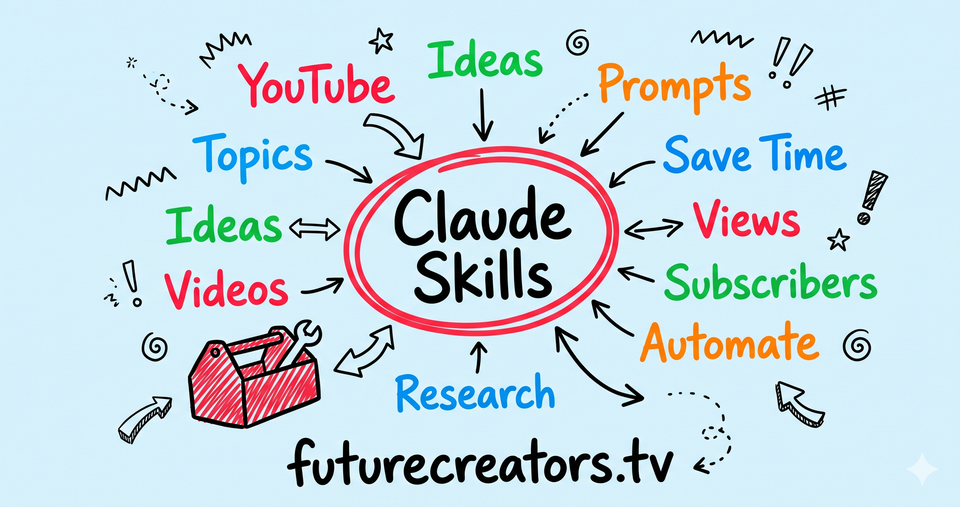
Imagine Claude helping you find the best YouTube topics to grow your channel. One of my videos found this way pulled in 1,200 subscribers and still drives views daily, a year later.
Competition, demand, title analysis, the whole thing.
Tools like vidIQ and 1of10 charge $30 to $50 a month for this.
I'll show you how to build it with Claude right now.
This is Part 1 of a two-part series. By the end of this piece, you'll have your own Claude skill that pulls powerful video topics you might have otherwise missed.
I'm Brian G. Johnson. Two-time author, silver play button holder, 14 million views driven across my channels. I launched this site to focus on AI and content creation done well. Glad you're here.
The Best Claude Code Setup for Non-Coders
I'll show you what I believe is the best way to get the most out of Claude Code. Especially if you're a non-coder.
Already comfortable with Claude Code? Skim ahead to the skill-builder sections.
Brand new?
Don't skip. I know it's cliché, but here's why it matters.
- The setup below is the most stable way to work with Claude.
- You'll get better output. Not all Claude setups are equal.
- It'll make your life easier.
Here's how to get set up.
- Install VS Code (free). Download from code.visualstudio.com. Works on Mac, Windows, and Linux.
- Open VS Code and create one folder for all your Claude work. Open that folder in VS Code. Everything you build lives here.
- Install the Claude Code extension. Free. It puts Claude in a panel on the right side of VS Code.
- Upgrade to Pro or Max. The free plan won't cut it. You need the usage headroom and the better models.
Plugins are small add-ons that extend VS Code. You only need a few. I'll cover the ones I use in another piece.
That's it. You're ready to build.
How to Install the Skill-Creator Skill from Anthropic
A skill is a set of instructions you write once. After that, one slash command runs the whole thing. Think of it like saving a recipe you can reuse forever.
The one you want first is called skill-creator. Anthropic made it. It's the skill that builds new skills for you.
Here's the funny part. I actually uninstalled it to film the video this piece came from. Then I struggled to get it back. The answer was so obvious it was embarrassing.
Just ask Claude.
Here's the exact prompt. Paste it into Claude and you're done.
Prompt to paste into Claude:
Install the skill-creator skill from github.com/anthropics/skills into my ~/.claude/skills/ folder. Clone the repo and place the skill-creator directory there so I can fire it with /skill-creator in future sessions.
Claude clones it. Works in any Claude Code environment. Now you can fire /skill-creator in future sessions and it'll walk you through building new skills.
Build a YouTube Topic Discovery Skill with Claude
Start a new session and fire the skill-creator skill. Then name your skill up front. Tell Claude something like: "The name of this skill is the YouTube Topic Discovery Skill."
Quick note. Claude sometimes reads the instructions instead of running them. If that happens, just say "fire the skill" and it will.
Here's what this skill does.
It uses YouTube autocomplete to surface a massive list of topic suggestions. It pulls them in with a free endpoint that automates the whole thing. You fire the skill, walk away, come back a few minutes later, and you've got a list of keyword phrases ready to process.
Type "container gardening" into the YouTube search bar right now. Those suggested predictions YouTube serves up? Those are what we're going to use, in a specific way, to build a full list of video topics.
Start with your seed phrase. Think about the video you want to make. Find a two or three word phrase that describes it. Type it into the search bar. That's your seed.
"Container gardening." "Halloween DIY costumes." "Affiliate marketing for beginners." Whatever fits your niche.
Tell Claude the first thing this skill should do when it runs is ask the user for their seed phrase. That's the input everything else works from.
Tell Claude to access the endpoint. Claude will pull autocomplete suggestions from this URL: suggestqueries.google.com/complete/search?client=youtube&ds=yt&q=[phrase].
Quick word on this one. It's undocumented and unofficial. Similar to an API but not exactly. Bad news, Google could kill it at any time. Good news, it's been around for ages and probably won't be.
We're going to program this to be safe. Some people abuse it and end up with their IP banned. We won't.
Tell Claude to drill the seed up to three levels. The skill takes your seed phrase, hits the endpoint, grabs the first suggestion, searches it, counts the suggestions, and repeats up to three levels deep. Each level that still returns 8+ suggestions confirms real popularity.
That's how a single seed becomes a map.
How to Score YouTube Keywords for Popularity
Heads up. This part gets a little nerdy.
Don't worry if you don't follow every detail. Claude will. Just paste the prompt below into Claude while you're building the skill and it'll handle the rest.
Popularity is scored on three signals. How many suggestions the seed returns (8 is weak, 14 is strong). How deep you can drill (Level 2 or Level 3). And where each phrase lands in the results (position 1 scores highest). Seed phrases score higher than alphabet expansions.
This is actually fairly complex. Too complex to walk through in detail here. Good news, the full prompt does the work for you.
Prompt to paste into Claude:
Score every phrase the skill collects using this logic:

Use client=youtube in the endpoint URL, not client=chrome. Chrome returns different suggestions in a different order.

Depth tier + floor (seed results only):
- Level 2 shallow (Level 2 returns 1-7 suggestions): floor 40
- Level 2 deep (Level 2 returns 8-14 suggestions): floor 50
- Level 3 (Level 3 returns 8+ suggestions): floor 65

Seed result position-1 scores by # of suggestions returned:
14=97, 13=94, 12=91, 11=88, 10=85, 9=82, 8=78, 7=74,
6=70, 5=65, 4=60, 3=55, 2=50, 1=45

Expansion (alphabet + prefix) position-1 scores:
14=75, 13=71, 12=67, 11=63, 10=59, 9=55, 8=51, 7=47,
6=42, 5=37, 4=32, 3=27, 2=22, 1=17

Position decay: score = S × (1 - (P-1) × 0.65 / (N-1)). Round to nearest integer.
Floor enforcement: seed results can't score below the depth floor. Expansion has no floor.
Hard cap: nothing scores above 97.

Deduplication and inheritance: if a phrase appears in both seed and alphabet/prefix results, it inherits the seed score. Exact string match only, no fuzzy matching.
Paste that into Claude during the build. It handles the whole scoring pass in one shot. Every phrase your skill returns is scored, so you can rank them later.
The Alphabet Method for YouTube Keyword Research
Next, tell Claude to build the topic list using the alphabet method.
Here's how it works.
Take your seed and append each letter a through z. "Container gardening a." "Container gardening b." All the way through the alphabet.
Each query pulls back real suggestions. That's how you turn one seed into hundreds of phrases tied to the same topic.
How to Filter Your YouTube Keyword List with Claude
Now you've got a list of 100 to 200 phrases. That's too many to film.
This is where most people stop.
It's also where Claude gets truly powerful.
The goal is simple. Identify the winners. Filter out the losers. 25 phrases is what you want to end up with.
There are a lot of reasons a topic is a winner. It's not always about views alone.
Consider two of my videos published around the same time. One has far more views but gained way fewer subscribers. The other has less than half the views and gained more than 1,200 subs.
That's why you really want to understand what makes a topic worth filming. It takes time to make a video. There need to be real reasons behind it.
Here are the three reasons I look for.
Reason #1: Low competition. Pull up the top 10 YouTube results for the phrase. Look at who's ranking. Now think about the big channels that dominate your niche. If they're not in the top results, that's an opening. That's a video worth making.
Reason #2: High intent alignment. The viewer's intent matches what your video actually delivers. My 1,200-sub video converted because those viewers wanted to grow a channel, exactly who I serve. Use the audience's own language. What are they searching for? What are they looking for? If that lines up with your video, subscribers follow.
Reason #3: Low competition can win even with skeptical viewers. Take a phrase like "is YouTube promotion worth it." Those viewers are skeptical, unsure, maybe not ready to grow a channel yet. Different audience. Does that mean you skip it? No. If competition is low, the video can still win. You'll reach people through recommendations, not just search.
Once you're down to your top 10 to 25, open YouTube and search each phrase yourself. See who's ranking. Watch for the big channels in your niche. If they're absent, that's a real opening.
Now here's the part most people miss.
Teach Claude who your audience really is. Who they are. What they're trying to do. What they know. What they're stuck on. What they care about. The more specific you get, the sharper the filter.
Write your audience profile once. Reuse it forever.
Have Claude interview you and write an audience profile file in your folder. Age, gender, location, what they struggle with, what keeps them up at night, how they feel about things. Save it. Your skill references it every run. You never repeat yourself. The filter gets smarter over time.
This is the real power of using VS Code. It's why I built the whole system around it.
Here's the prompt for the audience interview.
Prompt to paste into Claude:
Interview me to build a detailed audience profile for my YouTube channel. Ask me one question at a time. Cover:

- Who they are (age, gender, location, background)
- What they're trying to do or become
- What they already know and what they don't
- What they struggle with, what keeps them up at night
- How they feel about their situation and what they believe about the space
- What words and language they use when searching

After the interview, write a markdown audience profile file saved as audience-profile.md in my project folder. I'll reference this file from my skills so I never have to repeat this information.
Run it once. Answer the questions as honestly as you can. Save the file.
Then use this prompt to actually filter your keyword list.
Prompt to paste into Claude:
Filter the phrase list using the audience profile and popularity scores.

1. Reference the audience profile document (audience-profile.md or similar) in the project folder.

2. Use the popularity scores already on each phrase. If the phrases don't have scores, stop and tell me. The skill needs to be updated to include scoring based on the scoring matrix in the scoring prompt.

3. Before filtering, ask me what kind of phrases I want. Beginner or advanced? How-to or comparison? Any themes to focus on or exclude?

4. Filter the list down to 10 to 25 phrases.

5. Return the filtered list ranked by best fit, with a one-line reason for each phrase.

6. Save the filtered list to a markdown file (filtered-phrases.md) in the project folder so it's ready for Skill #2.
Claude asks you a couple of framing questions first (beginner vs. advanced, how-to vs. comparison, themes to include or exclude), then filters the list against your audience profile and the popularity scores already on each phrase. Off-intent phrases drop out. What's left is the short list worth filming, saved straight to a markdown file ready for Skill #2.
The skill also saves a markdown file with your seed, audience and intent info, the seed results table, the expansion results table, and any phrases that got filtered out. Every phrase is scored, so you can reuse the file later or feed it into other skills.
What's Next: The YouTube Competition Analysis Skill
What you just built is a YouTube topic discovery engine. Think of it as the tool that helps you spot opportunity so you can move forward and grow your channel.
Part 2 takes this to another level. The next skill identifies the weak channels in the top results for each phrase, giving you the chance to show up and get recommended on YouTube.
The follow-up piece breaks that down step by step. I'll link it here once it's live.
If you're building along with me, drop a comment with the seed phrase you're starting with. I read them.

Content strategist, author of Trust Funnel and Tube Ritual, and YouTube Silver Play Button recipient with over 25 years of experience helping creators build audiences online. He writes at FutureCreators.tv.
Member discussion