The Best Content Creation Strategy for 2026 and Beyond

What if you could build a content strategy that actually worked? One system. Multiple platforms. Real results. Picture this.
- Imagine simplifying your workflow so you're not spread thin across ten platforms burning out.
- Imagine showing up in multiple places, all from one piece of content.
- Imagine growing a subscriber list you actually own, for free, that you can reach anytime you want.
- And, imagine leveraging the very things the algorithms are currently rewarding, giving you an advantage most creators don't even know exists.

Hey, I'm Brian G. Johnson. I've been an online entrepreneur for over 25 years, driven millions of views on YouTube, and built everything as a one-man operation since 2003. What I'm about to break down is the content strategy that some of the highest-level marketers in the world are using. And that I'm using myself right now.
The best part? It's simple. It all comes down to finding your content sweet spot.
The Sad Reality
Most people aren't going to do this.
Most people are going to publish subpar content. Most people are going to press the AI button like it solves a problem.
It never will.
I guarantee you, because I've been here before and I've seen how this plays out.
And it's already getting eradicated. YouTube just started surfacing a new prompt to viewers. "Does this feel like AI slop?" with options ranging from "Not at all" to "Extremely."
That's not a suggestion.
That's a signal.
The platforms are giving users a button to flag low-quality AI content, and make no mistake, that data is going straight into the algorithm.
Here's the good news.
It's really not that complicated if you follow a step-by-step process. If you don't, it's overwhelming, and that's exactly why people struggle. They're trying to do everything at once instead of saying "OK, this week I'm going to focus on learning this one platform" or "this week I'm just going to publish one piece of content." As soon as you narrow your focus to the next step, it gets so much easier.
But most won't.
They're going to try to automate everything with AI. They're going to make bad decisions. They're going to get flagged, filtered, and left behind.
I use AI all the time. But I use it in a way that honors my voice. Keeps it authentic. Keeps me in the driver's seat. You can do the same. If you want to see exactly how, I wrote about it in detail here: How to Use Claude AI to Create Far Better Content.
If you think I have this all figured out.
Honestly, yeah, I sort of do.
Because, I've been working on figuring it out for months now.
I didn't have the direction. I wasn't sure. What I did have was 25+ years of experience and the willingness to keep showing up until the pieces started clicking.
And finally, it's clicking
All you can do is the same. Just mess around and publish something. But follow this blueprint, because doing so will give you an advantage. You'll tap into the very thing the algorithms are actively looking for, and you can literally bake it into the content you publish to give you an instant edge.
This is going to be a good one. And it starts with the one thing most creators get completely wrong about how content actually works.
Best Way to Create Content With Video, Audio, and Text
Here's the problem nobody talks about. You post on YouTube, TikTok, Facebook. You get views, maybe even a lot of them. But you don't own anything.
The algorithm decides who sees your stuff.
Subscribers used to mean something. Back in the day, when someone subscribed to your channel or liked your page, you had a direct line to them. That's gone. In 2026 you can have 100,000 followers and reach 2% of them on any given post. The platform owns the relationship, not you.
However, there's one source that still lets you reach your subscribers directly, every single time. Email. And the platforms we're about to talk about give you that for free, built right in.
Here's the engine that makes all of it work.
Words.
When you really think about content creation and online marketing, it's all words. A blog post? Words. A Facebook post? Words. A YouTube video? That's the spoken word. You can take the spoken word and turn it into the written word, which you can publish to a website, send as an email, and share across every platform you're on.
That's leverage.
One piece of content, built around one idea, one topic, one keyword, becomes the thing you publish to your blog. That blog post automatically goes out as an email to your subscribers. That same idea becomes the script for your YouTube video, and pieces of it can show up on Facebook, Twitter, or wherever else you decide to be.
Some people call this repurposing.
I'm going to be honest.
I was never a fan of repurposing. It always felt like you were watering things down, stretching one thing too thin. But this is different. You're not chopping up one piece of content into a bunch of weak little pieces. You're creating one strong idea and expressing it in the way each platform rewards.
This is exactly what I'm doing with this article right now, in real time. I'm writing this piece as a long-form article for my blog. When I hit publish, it goes out as an email to my subscribers. As I'm working on it, I'm creating images like the "Your Content Sweet Spot" diagram you saw earlier.

That image is going straight to Facebook later with a short post about it, maybe mentioning Google traffic or a recent update, with a link back here. Yesterday I saw that YouTube "Does this feel like AI slop?" screenshot, cleaned it up, made it pop, and posted it to Facebook on its own. That's not a separate content idea. It came directly from working on this piece.
Think about it like this. Once or twice a month, you write something with real meat on it. Step-by-step. Specific. Something you can interlink to, something that helps your Google rankings over time, something that helps people find your other content. That one piece gives you all these little pieces. Images, quotes, short posts that you can use on Facebook, Discord, Twitter, wherever. You're not coming up with new ideas for every platform. You're talking about the core thing you're already covering. And as mentioned, leveraging the power of AI makes this a lot easier. Check out this post if you haven't. It's powerful.
The goal is one piece of content every four to five days. Maybe once a week. Whatever works for you. You start with one platform, get comfortable, and then layer in the next one. Over time you'll have maybe three or four platforms, all powered by one central piece of content each week.
But none of that matters if you're creating content nobody's looking for. And that's where most people go wrong before they even start.
Content Creation for Beginners: Start With Who You're Trying to Reach
You've probably sat down to create something and thought, "What do I even talk about?" That feeling. The blank page. The blinking cursor. It's the number one reason people quit before they start.
Before you write a single word or hit record on a single video, you need to get clear on who you're creating content for. This is where a lot of people skip ahead and it costs them.
Think about the person on the other side of the screen.
- What are they struggling with?
- What are they searching for?
- What do they want to learn, fix, or figure out?
For me, I'm targeting people who want to learn about content creation. YouTube, blogging, list building, growing a following. People who want to leverage the new AI tools but do it in a way that feels authentic, because it is. Where they're not pushing a button and letting a robot write everything for them. They want to use AI to improve their writing and their work without losing their voice.
One more thing, and this is important. The content you create needs to come from your own experience. Your stories, your ups and downs, your perspective. It doesn't matter if you're brand new or you've been at it for years. Google's algorithm is actively rewarding experience and expertise in 2026. Content from someone who's actually done the thing gets boosted. That's your advantage. I broke down exactly how this works in [How to Increase Website Traffic Through Experience and Trust].
Once you know who you're creating for, the next step is understanding what they're actively searching for. And there's a free, dead-simple way to find out exactly what your audience wants. In about two minutes.

Content Creation Topics: Why Keywords Still Matter in 2026
Keywords.
Boring.
Heard that before.
I get it. Some people will tell you they don't matter anymore. But here's what's interesting. When you really look at content that does well online, there's almost always a keyword attached.
The vast majority of the time.
Think about tech bloggers covering the newest iPhone. They're targeting a keyword phrase based on that specific model. People covering hobbies like painting, sewing, or collecting are creating content around very specific topics, and those topics always include a keyword.
Keywords are the bridge between you and the person you're trying to reach. They're how the algorithm connects your content to the right audience and the right audience to you.
But here's the part most people miss. Keywords reveal intent. When someone types a specific phrase into Google or YouTube, they're telling you exactly what they want. The more specific that intent is, the easier it is to get them to click.
And when they click and you deliver on exactly what they were looking for? That's when they subscribe. That's when they take action. That's when everything starts working.
So how do you actually find keyword phrases? It's simpler than you think.

Step one. Go to Google and type in a two-word phrase your audience would likely search for. That's it. As you type, Google will show you autocomplete suggestions, and those suggestions are literally what people are searching for right now. You just typed two words and Google handed you a list of real keyword phrases people are actively looking for. That's instant insight into what your audience wants.
Step two. Look at the actual search results. The SERPs (search engine results pages). This tells you how competitive the phrase is. If you search "target audience definition" and the top results are Adobe and Harvard Business School, that's mission impossible. You're not outranking them. The likelihood you get traffic from Google on that phrase is thin to none.
But that's the whole point. You're not trying to compete with Adobe. You're looking for phrases where the competition is weak, where smaller creators or outdated content is ranking. That's where you have a real shot.

Step three. Get creative and dig deeper. I asked AI for alternative phrases people might search for around "target audience" and it came back with "audience avatar." So I searched "audience avatar example" and something interesting happened. The SEO difficulty score dropped to 32 out of 100. The obvious phrases were scoring in the 60s. Mission impossible. But 32? That's a real shot.
And look at what's ranking. Images, videos, and smaller creators like Daniel Budai showing up with "How to Build Your Customer Avatar Using AI." If someone like Daniel can rank there, you can too. That's exactly how you work smart. You create the kind of content you want to create, but you find the place that isn't so competitive.

When you're choosing what to create, think about three things. What you want to write about. What your audience is searching for and interested in. And what you can actually rank for. Instead of trying to hit a grand slam every time, just get on base. Find the phrase where all three of those things overlap. That's your sweet spot. That's where you publish.
Pay attention to keywords. Not because it's some old SEO trick, but because it tells you what people actually want. When you know what people want, it's a whole lot easier to give it to them.
You know who you're creating for. You know what they're searching for. But where does all of this content actually live? Because if you get this next part wrong, everything you publish disappears into the algorithm and you never see it again.
The Content Creation Framework: Your Home Base That Does Everything
If you're posting content and it only exists on someone else's platform, you're building on rented land. One algorithm change and it's gone. That's not a strategy.
That's a gamble.
You need a home base.
Think of it as a blog, but it's so much more than that. It's your blog, your newsletter, and your subscriber list all in one place. When you hit publish, three things happen at the same time.
- Your content goes live on the web where it can be found by Google.
- It gets sent as an email to your subscribers.
- And it lives on your site as a permanent piece of content that keeps working for you. Driving traffic, via image search, google search, and more. It's value.
Back in the day, I would create content on my blog, then separately send an email through AWeber to my subscriber list, and that was that. The new platforms let you do it all in one. You publish once and it handles everything.
Free.
And here's the part that gets really exciting. Once this is up and running, your YouTube channel gets more powerful too. When you publish that article, you can embed the YouTube video right inside it. So when that email goes out to your subscribers, they see the article and they see the video. You're immediately driving views and watch time to YouTube in that critical first hour or two. You're amplifying the signal. You're basically giving YouTube a boost every time you publish on your blog.
Two birds. One stone.
Actually, more like four or five birds.
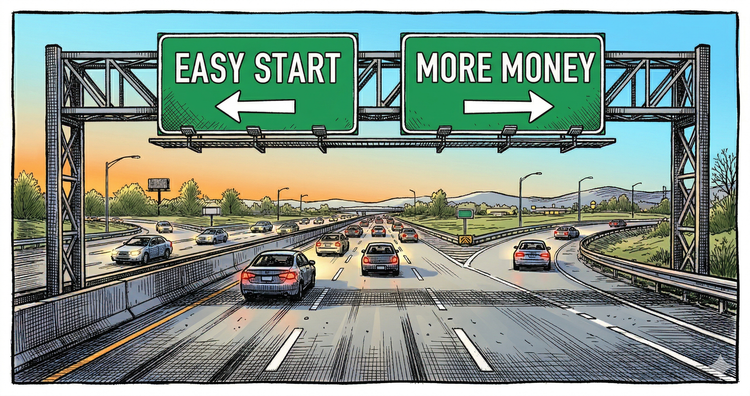
So what platform gives you all of this? There are two worth your attention. One is free and easy. The other is a long-term power play. Which one you pick depends on where you are right now.
Digital Content Creation Strategy: Substack — The Easy On-Ramp
If you're just getting started, Substack is probably where you want to be. It's free, incredibly easy to set up, and if you've ever used Word or Pages you'll feel right at home. It's growing fast. Gary Vaynerchuk went heavy on Substack in 2026 and even hired a dedicated strategist to manage it. That tells you how seriously the biggest marketers are taking it.
The trade-off is Substack takes 10% of your revenue.
But if you need something free and simple to get started, it's a great first step. You can always migrate later if you outgrow it.
But what if you want more than easy? What if you want your content to actually show up in Google search results and pull in traffic while you sleep?
Best Ways to Create Content and Monetize: Ghost — The SEO Power Play
Ghost is the platform I chose, and here's why.
Ghost is built from the ground up to perform well on Google. It's lightning fast, gives you a proper sitemap out of the box, and Google's bots have an easy time crawling your content. If you care about search traffic, and I think you should, Ghost gives you a real advantage. Because it's not just about search. When you publish, what's driving to honor that things that matter to viewers and Google you set yourself up not only to rank in search but to rank in AI citations. That's the future.
Pull Content Drives Conversions
Here's why that matters. Google traffic is pull content. The person is actively searching for something specific. They're telling you what they want. That makes it way easier to deliver, way easier to convert, and way easier to get them to subscribe. Compare that to push content on Facebook or Twitter where you're competing for attention mid-scroll. Pull traffic converts. That's what Ghost is built for.
When I set up my Ghost site, I requested three posts be crawled. Two hours later, they were indexed in Google. In 2026 that's a huge deal. Less than 20% of new sites get indexed that quickly. And with Ghost you pay a flat fee instead of a percentage of revenue, so as you grow it saves you real money compared to Substack's 10% cut.
Either way. Substack or Ghost. You need a home base. That's step one.
But your home base alone isn't enough. You need a platform where you show up consistently, build an audience, and drive people back to that home base. And there's one platform that's outpacing everything else right now.
Content Creation Strategy for YouTube and Podcast: The Platform That's Not Fading
Once your home base is set up, you need a primary long-form platform. If you're not sure which one to pick, I think YouTube is the smart bet.
Here's why. When we look at Google, there's a real conversation about whether search traffic will be around in ten years. It's fading. But YouTube is a completely different story.
The destination with YouTube is to watch, be entertained, and be educated in video format.
That's not going away.
YouTube is getting bigger every single year. It's absolutely exploding.
YouTube pays more than any other platform. There are more brands looking for YouTubers to do deals with than ever before. You can do long-form content, shorts, live streams. If it's video, YouTube is the play.
But don't just listen to what the experts say. Listen to your gut. If you're drawn to TikTok, do TikTok. If podcasting lights you up, do that. The platform you enjoy is the platform you'll stick with. And sticking with it is everything. Pick one format and go.
Once you've got your home base and your primary platform, there's a way to multiply your reach without multiplying your workload. It's easier than you think.
Best Way to Create Content on Facebook and Social Media
Here's the thing about adding a secondary platform. Once you understand your workflow and your home base is humming, it's not that hard.
Think about it.
You already know what you're publishing this week. You've got your blog post that's also your email that's also your YouTube script. Sharing your ideas on Facebook or Twitter at that point is just a natural extension of what you're already doing.
For me, Facebook is my secondary platform right now. I just shared my thoughts and ideas consistently and saw a massive spike. 100,000+ views in 28 days, up over 400%. Layering in Facebook was easy because I wasn't starting from scratch with what to say. I already had the content from my home base.
Your secondary platform could be Facebook, Twitter, TikTok, whatever makes sense for you. The goal isn't to be everywhere on day one. The goal is to be in enough places over time where you can grow an audience, gain subscribers, and tap into traffic from different sources. And always, always, link back to your home base so people have a chance to subscribe.
You've got the system.
Home base. Primary platform. Secondary platform. But there's a question nobody answers. How do you actually get started without drowning in the process? Because having a strategy and executing it are two very different things.
Best Way to Create a Content Calendar: The Publishing Sprint
You know the platforms. You know the strategy. But how do you actually execute without getting overwhelmed?
The answer is what I call a publishing sprint.
A sprint is a focused period, usually 30 to 90 days, where you commit to publishing consistently on one platform. You define what you're trying to accomplish, you pick the platform, and you go.
Workflow.
But here's what most people don't realize about a sprint. The real benefit isn't the content you publish. It's that the sprint forces you to figure out your workflow.
- How do you write a blog post?
- How do you format it?
- What do your images look like?
- How does the editor work?
- How do you come up with keyword phrases?
In the beginning it's rough.
When I started using Ghost, I hated the publishing process. It was confusing and clunky. But now? I paste in content that's already formatted with H2 tags, H3 tags, bold text, links, proper structure, and publishing takes minutes. That didn't happen on day one. The sprint made it happen.
And you don't have to figure it all out at once.
That's the beauty of it. The first time you just publish, that's the goal. Just publish and get the thing out. It doesn't have to be perfect. Two days later, publish again but this time think about your keyword phrases. Two days after that, start thinking about your images and your brand identity. You layer in one improvement at a time.
I've seen this work firsthand. When I did my first publishing sprint on YouTube, I went from about 1,000 views a day to 3,000 to 5,000 views a day. It was rough in the beginning. I was figuring out the workflow, figuring out my voice. But over time it started to pop. That sprint laid the foundation for steady growth over the next year, and then accelerating growth in year two.
The sprint works. You just have to commit to it.
But there's one thing that makes every sprint, every piece of content, and every platform work ten times harder for you. Most people either don't know about it or they're afraid to do it.
Is Content Creation Profitable? Your Secret Weapon
Here's the thing that will separate you from everyone else. It's not AI. It's not the platform. It's not the keyword strategy.
It's your personal experience.
Share your voice. Tell your stories. Create a digital footprint of who you are. Experience leads to expertise. Expertise leads to trust. And trust is what makes everything else work.
This is exactly where AI fits in. As a tool, not a replacement. I voice dictate, I do massive brain dumps, I structure content with AI, I have it cleaned up. But I lead.
The ideas are mine.
The experience is mine.
The voice is mine.
AI just makes it more accessible.
The draft is the skeleton. Your story is the blood.
Everything I've laid out, the home base, the keywords, the platforms, the sprint, none of it works without you in it. So let me leave you with exactly what to do next.

Content Creation Guide: Getting On the Path
If you've made it this far, you already know more than most people about what's actually working right now.
But knowing isn't the thing. Getting on the path is the thing.
You don't need to have it all figured out. I didn't. I went through a hard period. Big life transitions that took me out of the game. Finding my way back has been one of the most challenging things I've ever done. And if I'm being honest, there were months where I felt like I just wasn't living up to my potential.
But I kept taking steps. I kept showing up. And the pieces started clicking.
So here's what I want you to do. Pick your home base. Get on Substack or set up a Ghost account. Create something that allows you to reach subscribers on a regular basis. Publish your first piece of content. It doesn't have to be perfect. It just has to exist.
Then stay on the path long enough to see it start working. Not three posts and done. Not a video every other week for a month. I'm talking about locking in. Playing the long game. A 30 to 90 day sprint where you're all in.
The more you test, the more you try, the more you tinker, the more likely you are to find your way and start generating the results you're after. That's not a theory. That's what's happening for me right now, in real time.
This is my path. And I think if you look at what I've laid out here, you might find that a lot of it could apply to yours too.
The choice is yours.
But the path is waiting.

Content strategist, author of Trust Funnel and Tube Ritual, and YouTube Silver Play Button recipient with over 25 years of experience helping creators build audiences online. He writes at FutureCreators.tv.
Member discussion